




Quality Control and Defect Detection
The textile industry, one of the oldest and most essential sectors globally, has undergone tremendous technological evolution over the years. From hand looms to modern automated weaving machines, the pursuit of efficiency, consistency, and superior quality has been a constant theme. In recent years, Artificial Intelligence (AI) has emerged as a game-changer, especially in the realm of quality control and defect detection. With growing consumer expectations, stringent compliance standards, and a highly competitive market, textile manufacturers are increasingly turning to AI-based solutions to ensure flawless products and streamline operations.
This blog delves into the role of AI in textile quality control, its applications in defect detection, benefits, challenges, and the future scope of AI-driven quality assurance in the textile industry.
The Importance of Quality Control in Textiles
Quality control (QC) is the backbone of the textile industry. It ensures that fabrics, yarns, and finished garments meet industry standards and consumer expectations. Poor quality can result in defective products, financial losses, brand reputation damage, and customer dissatisfaction.
Traditionally, quality control involved manual inspection processes where skilled workers checked fabrics for defects such as:
- Slubs and knots: Irregularities in yarn that cause thick or thin spots in the fabric.
- Color variation: Differences in dyeing that can affect uniformity.
- Weaving defects: Issues like broken threads, missing picks, or misalignment in woven fabrics.
- Stains and contamination: Accidental dirt, oil, or foreign particles.
While human inspection has its advantages, including experience and adaptability, it is often time-consuming, subjective, and prone to fatigue-related errors. In high-volume production, traditional inspection methods cannot consistently maintain high accuracy levels.
Enter Artificial Intelligence in Textile QC
Artificial Intelligence, specifically machine learning (ML) and computer vision, has revolutionized quality control in textiles. AI systems can analyze massive volumes of fabric images and data in real-time, identifying defects far faster and more accurately than human inspectors.
AI in textile QC generally involves:
- Data Collection: High-resolution images of fabrics or yarns are captured using cameras or scanners.
- Data Processing: Pre-processing of images to enhance defect visibility and reduce noise.
- Defect Detection Algorithms: Using machine learning models, patterns of normal and defective textures are identified.
- Classification & Reporting: Detected defects are classified by type, severity, and location, enabling quick action.
These AI systems rely on deep learning neural networks, particularly Convolutional Neural Networks (CNNs), which excel in visual pattern recognition tasks.
Applications of AI in Textile Defect Detection
AI is transforming defect detection at multiple stages of textile production. Here’s how:
1. Fabric Inspection
Fabric inspection is critical in woven, knitted, and nonwoven textiles. AI-powered systems detect:
- Holes, tears, and cuts
- Slubs and knots
- Uneven dyeing or color deviations
- Weaving and knitting errors
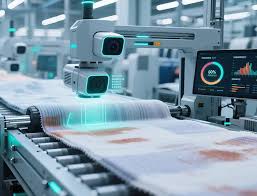
High-resolution cameras, combined with AI algorithms, can scan rolls of fabric at high speeds, detecting defects that are often invisible to the naked eye. For example, a deep learning model can differentiate between a harmless fiber variation and a defect that requires fabric rejection.
2. Yarn Quality Monitoring
Defects in yarn can propagate and magnify in fabrics, affecting the final product quality. AI-powered sensors can:
- Monitor yarn tension and consistency
- Detect thick and thin places
- Identify broken or frayed yarns
By integrating AI in the yarn manufacturing stage, manufacturers can minimize downstream defects, saving costs and reducing waste.
3. Color and Pattern Consistency
AI algorithms can compare fabric color and patterns against standard references. They can detect:
- Shade variations
- Uneven printing
- Misalignment of designs
This is particularly valuable for fashion and home textiles, where consumer perception of color and pattern is critical.
4. Automated Fabric Grading
AI systems can automatically grade fabrics based on quality standards. Fabrics with minor defects may be graded lower, while perfect rolls get higher grades. This reduces subjective bias and ensures consistency across batches.
5. Real-Time Defect Alerts
Integration of AI with production lines enables real-time defect detection. When a defect is detected, the system can immediately alert operators or automatically halt the machine, preventing defective production from continuing.
Advantages of AI in Textile QC and Defect Detection
Adopting AI in textile quality control offers several compelling benefits:
1. Higher Accuracy
AI systems, especially deep learning-based models, consistently detect subtle defects that humans may miss. Accuracy levels often exceed 95%, ensuring superior product quality.
2. Increased Speed and Efficiency
Manual inspection is slow, especially for large fabric rolls. AI-powered cameras and algorithms can inspect fabrics at production line speed, dramatically increasing throughput.
3. Cost Reduction
Reducing defective products, minimizing rework, and lowering labor costs contribute to significant savings. AI also reduces the need for large inspection teams, optimizing operational efficiency.
4. Consistency and Objectivity
Unlike humans, AI doesn’t experience fatigue or subjective bias. Every fabric is inspected against consistent criteria, ensuring uniform quality.
5. Data-Driven Insights
AI systems store and analyze defect data, enabling manufacturers to identify recurring issues, track machine performance, and implement preventive maintenance strategies.
6. Environmental Sustainability
By reducing defective production and minimizing waste, AI contributes to more sustainable textile manufacturing.
Challenges in Implementing AI in Textile QC
While AI offers remarkable advantages, textile manufacturers face several challenges during implementation:
1. High Initial Investment
AI systems, including high-resolution cameras, sensors, and computing infrastructure, require significant upfront investment. Small and medium-sized enterprises may find it challenging to adopt immediately.
2. Data Dependency
AI models require large datasets of fabric images with labeled defects to train effectively. Collecting and annotating such datasets can be time-consuming and costly.
3. Integration with Existing Systems
Integrating AI into existing production lines may require modifications in machinery, software compatibility adjustments, and staff training.
4. Limited Adaptability to Novel Defects
AI models trained on historical defects may initially struggle to detect new or rare defect types. Continuous model updating and retraining are essential.
5. Resistance to Change
Some workforce members may be skeptical about AI adoption, fearing job displacement or doubting its effectiveness compared to human inspectors.
Real-World Examples of AI in Textile Quality Control
Several textile manufacturers globally have successfully implemented AI-based defect detection systems:
- Texpa (Germany): Uses AI to monitor knitting machines and detect yarn irregularities in real-time.
- Oerlikon (Switzerland): Implements AI for automated fabric inspection, ensuring precise detection of weaving defects and color deviations.
- Chinese Textile Industry: Many factories employ AI-powered cameras and deep learning models for roll-to-roll fabric inspection, reducing rejection rates and increasing export competitiveness.
These examples demonstrate AI’s potential to transform textile quality assurance into a fast, accurate, and cost-effective process.
Future of AI in Textile Quality Control
The future of AI in textile quality control looks promising, with advancements likely to address current limitations. Some trends include:
1. Edge AI and On-Machine Defect Detection
Instead of relying on cloud-based processing, AI models deployed at the edge (directly on machines) can detect defects instantly without network delays. This is ideal for high-speed production lines.
2. Integration with IoT
IoT sensors combined with AI can monitor machine conditions, yarn tension, and environmental factors to prevent defects proactively rather than just detect them.
3. Predictive Quality Control
AI can analyze historical production data to predict potential defects before they occur, enabling preventive measures that minimize waste and downtime.
4. Cross-Industry Collaboration
Fashion, home textiles, and industrial textiles are increasingly adopting AI-driven QC. Sharing AI models and defect datasets across sectors could enhance accuracy and adaptability.
5. Sustainability and Circular Economy
AI can support sustainable textile practices by minimizing waste, optimizing dyeing processes, and improving recycling quality through automated defect sorting in recycled fibers.
Conclusion
Artificial Intelligence is rapidly redefining quality control and defect detection in the textile industry. By leveraging computer vision, machine learning, and predictive analytics, textile manufacturers can achieve higher accuracy, speed, and consistency while reducing costs and environmental impact.
While challenges such as high initial investment, data dependency, and workforce adaptation exist, the long-term benefits make AI a strategic necessity for textile businesses aiming to stay competitive in a demanding global market.
In the coming years, AI’s integration with IoT, edge computing, and predictive analytics will further revolutionize textile manufacturing, enabling near-zero defect production and sustainable operations.
For textile professionals and manufacturers, embracing AI is no longer just an option—it is becoming a critical step toward operational excellence and market leadership.

https://shorturl.fm/JuwS6
https://shorturl.fm/VvEYK